Hello again!
A toast to all of you — the readers. Yes, ... you are the true gift to any writer, the ones who make us breathe life into words and give meaning to every page written in solitude.
And a toast as well to life itself — with its light and its shadows — to all that tests us, shapes us, and quietly transforms us along the way.
L’chaim! 🥂

Welcome to my “brief” story of how it all began…
I was born in a small town nestled between green mountains and drifting mists, in a corner of northern Spain called Sama de Langreo, in the province of Asturias. Although, truth be told, I was meant to be born in Gijón, where we were living at the time.
Gijón lies just over thirty kilometres away from Sama— about nineteen miles — but in those days, that distance felt immense. The journey meant narrow secondary roads, endless curves, and potholes that rattled you to the bone.
My mother — determined and courageous — decided to visit my grandmother when she was already well advanced in her pregnancy. And had she not been prevented from returning home that very day, I might well have been born on a bus 😄 — somewhere between the rumble of the engine and the sharp jolts of the winding road.
Sometimes I wonder whether that unsettled beginning quietly set the rhythm for my life: movement, change, travel.
🚢🌎
I was only three years old when we crossed the ocean bound for Brazil, aboard the then-renowned passenger and immigration ship Alberto Dodero. I have no clear memories of the voyage itself, yet I distinctly remember the feeling that something immense was unfolding — something far greater than I could possibly understand.
In the weeks before our departure, there had been endless packing, anxious preparations, whispered conversations, and a tension in the air that even I could feel. I didn’t truly understand what was happening, but I sensed the nerves, the urgency, the weight of change. For a child so small, the world suddenly felt unsettled.
I hadn’t seen my father for some weeks and missed him with an ache only a child can feel. He had left ahead of us to prepare the way, to find work, and to lay the foundations of our new life — as so many immigrants did in those days. Part of my oversensitivity during that time came from how deeply I longed for him. I felt alone — almost abandoned — even though I was safely beside my mother and my brother. It was not a physical loneliness, but the quiet anguish of missing one particular embrace.
I was a sensitive child; I grew seasick easily and struggled through that long crossing, caught between the restless waves and my own longing.
When we finally arrived in Santos, at the port of São Paulo, I saw him from the deck — down below, waiting for us. And in that moment of overwhelming joy… it felt as though I were seeing God.
We lived in São Paulo for three years — years that, without my even realizing it, quietly planted the very first seed of words within me.

Here we are in Sao Paulo, Brazil... In Ramos de Açevedo Square.

Photo from an excursion to Our Lady Apareçida. The basilica was still under construction at the time (1963).

Here we are — the whole family — during our last days in São Paulo, Brazil, at a fair. It’s one of the few photographs in which my father appears. He almost never showed up in pictures; he was usually the one behind the camera, capturing and preserving our memories. This time, though, a friend — also Spanish — took the photo for us.
It was there, in Brazil, that my father bought me my very first book. I must have been about four years old — an alphabet book in Brazilian Portuguese, filled with exotic animals that felt almost magical to me. I can still see the pages: A for anaconda, O for onça — the jaguar, T for tapir... The words sounded like mysterious songs, rich and unfamiliar, yet somehow already mine.
That book became my treasure. My father would patiently point to each letter, teaching them to me one by one, as though he were unveiling an ancient secret. In those quiet moments beside him, language felt sacred — a door slowly opening.
Later came another small and dearly loved book: Onde está o patinho? (“Where Is the Little Duck?”). I still keep it, like a precious relic of those happy moments. With it, I learned to join letters together, to form words, and to discover that behind those simple black marks on a page entire worlds were waiting to unfold.
Portuguese was the first language in which I learned to read. Although I don’t write it or speak it fluently, I understand it, I can read it, and I can make myself understood. I can manage, as one might say — but it still lives within me, like a soft melody from childhood that never quite fades.

My treasured relic from the past... my first steps.
🚢🌍
Shortly after I turned six, we packed our bags once again. This time, our destination was South Africa.
Those were years of migration — years of quiet promises and constant beginnings, of starting over without maps or certainties, guided only by hope. But this time we were together — all of us — and although the journey was long, it felt brighter and lighter to me.
At the port of Santos, we boarded the Tegelberg, a Dutch-flagged ship that would carry us toward the unknown.
And during that long voyage, my stomach gently reminded me once again that the sea and I were never destined to be close friends. I got seasick… again. 😅

A stopover in Rio de Janeiro on our way to South Africa — a peaceful walk along Copacabana Beach, forever preserved in this photograph, carrying with it the memory of that special moment.

Aboard the Dutch ship Tegelberg, my mother and I sharing a quiet moment together, resting side by side in a hammock, as the ocean carried us toward a new chapter of our lives.


My brother and I aboard the Tegelberg, in two precious moments captured as we arrived in Cape Town, South Africa — carrying with us the emotions of a journey that marked the beginning of a new chapter in our lives.
After a few days in Cape Town, where the immigration authorities — and, I believe, the Spanish Embassy as well — formally registered us as new immigrants to the country, we moved on almost immediately to Johannesburg.
I have only a hazy memory of that train journey… aboard the famous Blue Bird. We travelled in our own sleeping compartment, and everything felt like something taken straight from a film. The gentle rhythm of the train on the tracks, the narrow corridors, the quiet intimacy of that small private cabin… It felt like living inside a cinematic scene, suspended between a past we were leaving behind and a future we had not yet begun to imagine.
It was in Johannesburg that my father found his first job in South Africa, working for an Italian man who, over time, became much more than an employer. He was a loyal friend — almost like a guardian angel to our family.
Thanks to him, my parents were able to enrol my brother and me in school. We had only just arrived in the country, stepping into a completely new world with a different language and an unfamiliar system. Everything felt overwhelming, and the language barrier made even the simplest tasks seem complicated and distant.
In that very first moment of our new life, his help meant far more than we could have imagined. He guided us patiently, translated when necessary, and opened doors that might otherwise have remained closed. Because of his kindness, we were able to enrol in school and begin building our future from the very start. It was a gesture that left a lasting imprint on our journey.
It was my very first school, in Orange Grove, Johannesburg. There, I began again from the beginning: the alphabet, the syllables, the first simple sentences… but this time in English.
English was not merely a language I learned; it was a language I lived. I breathed it in the schoolyard, heard it in the streets, and gradually wove it into my games and my thoughts. At home, however, we continued speaking Spanish. My father taught me to write it carefully, as though he were protecting a precious inheritance. And so I grew up between languages, like someone living in several homes at once.
That generous Italian man often brought us storybooks and comic strips in his own language. “For the bambini,” he would say to my father, with a wide, musical smile. Without even realising it, Italian quietly settled into a corner of my memory as well.
I don’t write or speak it fluently — that is true. But I manage, sometimes combining words with gestures and with the intuition that comes from years of living among languages. I can make myself understood. And, most importantly, I understand it. I can read it, listen to it, and feel it close and familiar — like a distant cousin who, although living in another country, will always remain part of the family.

A few of the Italian storybooks that I have kept to this day. My father would also bring us Walt Disney comics in their Italian edition, Topolino, which quietly became part of my childhood memories.
But if I had to name my mother tongue, I might say it is English — even though, strictly speaking, it is not. It is the language I studied, the language in which I dreamed, the one I absorbed and grew up with. It is the language in which I was educated and through which I learned to see the world from a perspective beyond my own.
Yet my identity was formed in overlapping layers: Spanish at home; Portuguese in my first books; Italian in those gifted stories; English in the wider world — in discipline, in structure, in the way I learned to think, to reason, and to express ideas.
Even my personality was shaped, in many ways, by the English-speaking environment around me. There is something quietly Anglo-Saxon within me — in my sense of privacy, in my punctuality, in the way I feel deeply without always showing it. At times, I even feel closer to that restrained expression than to the Spanish openness.
Perhaps I carry a little of both worlds. English speakers sometimes describe me as too “open” — or even “passionate” — while Spanish speakers may perceive me as somewhat reserved, almost English in demeanor. Cold and stiff… maybe even a little posh! 😁
So depending on where I am, I can apparently be either too emotional or too reserved. It seems I have mastered the art of confusing both sides equally! 😁
Because, in the end, we do not truly belong to just one language or one place. We are the echo of all the voices that have lived within us.
🌎🌍
My childhood was simple, even somewhat quiet. But inside, it was a fertile landscape. Every move, every new language, every book that arrived at Christmas or on my birthday was silently shaping something within me. While other girls delighted in new dolls, I felt a deeper excitement at the sight of a fresh notebook, a pen, a sharpened pencil, or a brand-new book waiting to be opened. Oh, don’t get me wrong — I enjoyed dolls too… even today! 😁
I loved copying words. I would rewrite entire stories simply for the pleasure of writing — of watching ink give form to thoughts that were not always my own. Perhaps because my life did not have dramatic twists, I sought adventure on the page. Sometimes through words, sometimes through drawings.
I also loved illustrating what I wrote. People often said that I had inherited my father’s gift for drawing — they had been saying so since I was very small. And I enjoyed it… I still do, even today. Though, in my opinion, I am nothing like my father. He was a truly talented designer. He could draw almost anything.
I never kept a diary, although the idea always appealed to me. Maybe I felt I had nothing particularly interesting to record… yet, without realizing it, I was already writing something much larger: the story of a girl who discovered that the world could fit inside a book — and that words could become home when everything else kept changing.
With my dolls, I didn’t play “house” or “mommy.” Instead, I would line them up carefully, perfectly arranged, and place a sheet of paper and a pencil in front of each one, as if they were sitting in a classroom. I would dictate… and they would “write.” 😁
Believe me… they made a lot of mistakes, so I had no choice but to punish them! 😆
It seems that even then, destiny was quietly whispering the path my life would eventually follow. (Later on in life, I became an English teacher.)
Although I liked dolls — and I still do, if I’m honest; I still keep most of them… intact, though their clothes are now slightly worn and faded 😊 — I was usually given baby dolls, the kind you are meant to cradle, feed, and care for.
I was never given Barbies, even though I asked for them again and again from the age of eight or nine. My mother chose the dolls she preferred — the ones she had never owned as a child. I suppose that was the reason: those baby dolls that could be hugged, dressed, and tended to, almost like daughters. But they were never really my type.
I was fascinated by Barbies. They represented something different: young, independent, elegant women with a world of their own to explore. To me, they were not merely dolls; they were possibilities — small promises of the future, stories waiting to be written.
🌎🌍
During my childhood, we moved five or six times — always from one place to another. I attended five different schools: three primary schools (the first one, Orange Grove Primary School, only for a few weeks, when we had just arrived in the country and were still settling in) and two high schools. We began in Johannesburg, then moved to Pretoria (where my younger brother was born — and suddenly we were three!), and later returned to Johannesburg, where I completed my schooling before eventually going back to Spain.
My father was always searching for better working conditions and a more decent salary — although, as people say, we never “made it big” or became wealthy. And so we kept moving, opening new chapters without ever having much time to put down roots.
I grew accustomed to not becoming too attached to places, or overly invested in new friendships. Moreover, as I was — and still am — rather introverted, I didn’t make many close friends. And so my school years unfolded in constant motion.


My first school photograph: Observatory Girls Primary School (Johannesburg). My second primary school (which could almost be considered my first, since the one in Orange Grove lasted only a few weeks). It was so close to home that I barely had to walk — just around the corner. My brother’s school was a little farther away, but not by much. Here we are with Mum, arriving home.


Two moments from one of our first Christmases in South Africa, 1967 or 1968: before and after opening the presents.
Once in high school, we had to choose a foreign language as a compulsory subject: German or French. I chose French — yet another language added to my growing collection 😁. I came to it a little later, during my teenage years, learning it slowly, step by step, word by word. I cannot claim to master it completely, but I can read it, understand it — especially if spoken gently and not too fast — and make myself understood. In short, I can manage… 😁
Vive la France!
And let’s not forget that although the school was English, we also had a second language that was absolutely compulsory — there was no escaping it… Afrikaans, of course! At the time, I managed it quite naturally at school, especially in Afrikaans class, where we usually used it. But once I stepped into real life, I hardly ever used it, and little by little most of it slipped away. Still, the language remains very familiar to my ear. Even now, I can sometimes catch the meaning of what people are saying and even respond a little. Back then, I must confess, I didn’t like it very much… yet today I find that I miss it.
So, someone might think I’m a polyglot, but I would say I am mostly bilingual. I truly master English and Spanish; the other languages I simply navigate as best I can. But I love languages. There is something deeply beautiful about being able to communicate with people from different parts of the world — especially in their own languages.

Starting my first year of high school at the age of twelve: Hillview High School, Pretoria.
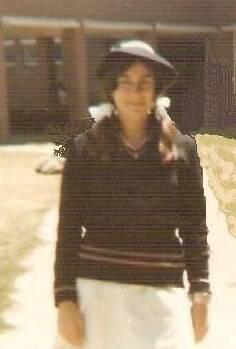

My final years in high school: Johannesburg High School for Girls (Barnato Park). I was sixteen. It was my last year before returning to Spain.
In South Africa, the school year begins in January and ends in early December. So I always started each new school year just after my birthday and finished it just before turning another year older. This photograph was taken in November 1975 — only a few days before my birthday (7 December) and the end of the school year. It was my final year in school before we returned to Spain — a quiet moment suspended between endings and new beginnings.

The three of us, siblings in South Africa, somewhere around 1974 — a cherished memory from another time.
🌎🌍
When I turned fourteen, my older brother — who was already working — gave me a Barbie with two extra outfits. Even though I was supposedly almost “too old” for dolls, that gift filled me with immense joy. I still have her… with barely four hairs left on her head 😊.
That doll inspired me as though she were a real girl. I wanted to give her a life of her own, but I didn’t know how. I imagined turning her into a model and organizing a fashion show — runways, spotlights, different outfits, dramatic entrances. But just her alone? She needed companions, more models, more clothes, more stories. I even dreamed of photographing her in different looks, like the pages of a fashion magazine.
But it remained, quite simply, an impossible dream. I didn’t even have a camera — and developing film was expensive. I had no other Barbies, no additional outfits. I didn’t receive an allowance either; in my home, we were never given spending money. And so that small creative universe stayed suspended in my imagination.
My first frustrated dream.
The following year, my brother surprised me again with another unexpected gift: an “Action Jackson,” one of those military action figures, complete with two uniforms. He was slightly smaller than Barbie, but I was just as delighted — perhaps even more so. I have always been fascinated by uniforms, by heroes, by stories of courage and war.
That doll felt real to me as well. I wanted to invent missions for him, action scenes, tales of bravery and purpose. And although he was shorter than Barbie, in my imagination he could easily have been her boyfriend 😄 — I already had an entire storyline prepared. But once again, everything remained in the realm of fantasy.
I still have him too — now somewhat battered and worn from so many imagined battles 😁 poor thing…
And so my teenage dreams remained exactly that — dreams. Simple, quiet, and sometimes frustrated… filled with stories I did not yet know how to bring to life on the page.
🌎🌍
I was just six months away from turning eighteen when my parents decided to return to Spain. They had been considering it for some time, as South Africa was becoming increasingly unsafe due to the tensions surrounding apartheid.
I finished high school in December 1975, and in January 1976 I began working at the Johannesburg post office to fill the time. My first job! I felt grown-up, responsible, independent — as though a new chapter of adulthood had already begun.
But it didn’t last long — about three months. Then came the suitcases, the preparations, the farewells. I had to leave behind the country that had helped shape my identity… even though the idea of returning to Spain did not fill me with enthusiasm. The few holidays we had spent there — only twice — had not awakened any particularly strong emotions in me.
I remember the first visit clearly. My father had to work, and besides, plane tickets were quite expensive at the time, so only my mother, my older brother, and I travelled to Spain when I was eight (my younger brother had not yet been born), while my father stayed behind — we could say he remained “holding the fort” 😊.
Arriving in Madrid was pleasant enough, but once we reached Asturias, in the middle of winter, everything felt dark and rain-soaked. Through a child’s eyes, the landscape seemed almost black and white. Even the predominance of dark clothing — so often black, especially among the elderly — reinforced that impression. It left me with a quiet sadness I could not quite explain.
The second time we travelled there, we went as a complete family. I was fifteen, and my little brother was three. It was certainly different — I was already a teenager by then, more observant, more aware of how the world worked — yet the experience was not particularly exciting.
Although I was surrounded by relatives and family friends, many of whom I barely knew, the culture — the way people spoke, behaved, and related to one another — felt strangely foreign to me. They seemed rather talkative, often inclined toward gossip, which did not quite suit my temperament.
And their language… well, it sounded almost shocking to my ears. There seemed to be a swear word every other word. Yet for them, that was simply the normal way of speaking — something that, even today, I have never quite managed to get used to.
I remember feeling slightly out of place, uncertain of where I truly belonged.
Even my cousins thought I was strange… distant, reserved — even “posh.” 🥴
So the idea of going "home" did not stir much anticipation in me.
Yet I was still underage. When my parents decided to return, I had no say in the matter. I simply had to follow them back to Spain. It was mid-June 1976 — not a date I remember with any fondness.
Once again, life changed its setting without asking for my opinion.
🌎🌍
I didn’t know what the future held, but moving to another country — a place that was officially “my country” — felt like a quiet opportunity for a fresh start. A new place… finally, I would begin my adult life. My whole life lay ahead of me, and I believed — with the certainty only youth allows — that countless opportunities were waiting. At nearly eighteen, I arrived ready to take on the world, convinced that a new life was just beginning.
Instead, Spain greeted me with a brutal awakening. The dream I had carried with me shattered far sooner than I could have imagined. Nothing turned out the way I had hoped, dreamed, or planned. What I thought would be a new beginning quickly became a deep and sobering disappointment.
Adapting was not easy. Circumstances did not allow me to leave for another country, start over somewhere else, or find a place of my own.
For a long time, I felt as if something inside me was slowly fading — suspended in a place that never truly felt like home.
But that is another story… one I am saving for my full autobiography, when I find the courage to tell it without filters: a life marked more by disappointments than celebrations, shaped by frustrations, anger, and moments of helplessness that I rarely put into words. Yes, even if what I have shared so far may sound adventurous — even bright — it belongs to youth: to inexperience, innocence, and that fragile naivety that still shields you from the harsher edges of reality.
My adult life in Spain… well, that is an entirely different chapter.
For now, I choose to hold on to the colour 💛💚💙🧡 — to the few moments that brought light into my story. And when the colour was missing, I tried to paint it in myself. Because, as the saying goes, I always tried to look on the bright side. 😁
🌎🌍
The years went by. Yes, in Spain. Many of them — more than I would have liked. And they still continue…
I am still here… despite the passage of time, despite the years in which I never quite felt fully adapted — as strange as that may sound.
I worked in jobs that, at the time, I wanted to believe were important. In reality — and almost paradoxically — they were simply the opportunities that came my way, the roles I was allowed to fill. Over time, I came to see them as temporary patches over a life that never quite managed to take off.
The salaries were modest, almost symbolic. But when necessity presses hard, you hold on to whatever you can — even clutch a straw.
Most of my work was as an English teacher in language academies, and I discovered that I didn’t dislike the profession; in fact, I discovered that I really enjoyed it. I also worked as a bilingual secretary for foreigners who were passing through, and during that period I felt useful, valued, and understood.
Yet the contracts were always temporary. Always replacing someone. Always beginning again. Never permanent, never offering the kind of stability that allows you to breathe without worrying about the next month. It felt like running on a treadmill that never truly moves forward — constant effort, yet no real arrival.
Curiously, it was almost always foreigners who offered me an opportunity, as if my natural place were somehow slightly outside the centre — never fully inside.
I never understood why no Spanish company — no Spanish employer — extended that same trust. What were they seeking? Experience? But if no one gives you the chance to gain it, how are you supposed to acquire it?
In my final working chapter, I returned once again to where it had all begun: teaching English in an academy. It felt strangely fitting. English came back into my life like a guiding thread, as though it had never truly left me. In many ways, it never had.
That language is part of who I am. I don't just speak English—I feel English-speaking. It is woven into my identity, into the way I think, perceive the world, and express myself. It belongs to the deepest part of me.
(But now, after so many years back in Spain, I sometimes feel as though I am losing even that… as though a part of my identity is quietly fading away. I can feel my spoken English becoming less fluent than it once was. Words no longer come as effortlessly as they used to, and that frightens me. It is as though the ease and spontaneity I once had are slowly slipping away through lack of use. I hate that. What unsettles me even more is that I find myself thinking in English less and less often. That isn't me. Or at least, it never used to be.)
I worked at that academy for ten long academic years… or was it eleven? Sometimes I lose count. The contracts were renewed each September, so every autumn felt like a new beginning — though in truth, it was always the same story continuing under a different signature.
I never fully adjusted to the rhythm of the academic calendar in Spain — the course beginning when the calendar year is already more than halfway through, running from September to June. Although 🤔 now that I think about it, perhaps that is not uniquely Spanish, but simply the pattern of the Northern Hemisphere. Or is it?
And so nearly eleven school years passed… more or less. Without a doubt, it was the longest professional chapter of my life. And I was quite happy! Here, the academic year ran from October to May — always with a start date and an end date. Always temporary. Always dependent on a renewed contract. As if I never fully belonged, as if my stability hung each year from an invisible thread.
Then the pandemic arrived… and the entire world came to a standstill.
And from that moment on… so did my life.
🌎🌍
When the world slowly began to wake up again, I was already sixty-one. Who would offer me a job at that age?
It felt as though the ground had opened beneath my feet. My future suddenly turned grey, as if someone had lowered the shutters without warning. And yet, inside, I did not feel finished. I still felt young. I knew I still had so much to offer, so much to learn, so much to give.
But I felt trapped inside an invisible room — no door, no horizon. Confined in a country where I had never fully managed to feel that I belonged. It was a strange contradiction: to be in what was officially my homeland, and yet feel like a stranger within it. As if I had always lived between borders — except this was the only one I did not know how to cross. The circumstances held me back, unseen yet unyielding.
And it was in that enforced silence that something unexpected began to take shape.
📔📖📚
During my final working years, while teaching at the last academy, I found my way back to Barbies — not as childhood toys, but as collectible pieces. With my modest salary, I allowed myself to buy one from time to time. At first, I placed them carefully on a shelf. Gradually, I added more. I gave them names. There they stood, arranged in quiet elegance — many dressed in black, as though attending a refined, silent cocktail party.
One day, almost by chance, while browsing online, I discovered action figures from the World Peacekeepers collection. Instantly, I was reminded of my old and much-loved Action Jackson. But what truly captured my attention was that these new figures were the same size as the Barbies. And unlike the versions of the past — identical except for their uniforms — these had distinct faces, individual expressions, different hair colours. They were personalities, not repetitions.
The same evolution had taken place with the Barbies. There were redheads, blondes, brunettes, Black dolls, mixed-race dolls, fair-skinned dolls — each with a different face. No longer the same mould simply dressed in different clothes; now they reflected diverse identities. That, to me, was the most meaningful change: they finally represented real variety. And they were all fully articulated!
Out of pure curiosity — and simply to see what they were truly like — I ordered one of those “brave little soldiers.” 😂
When he arrived, I thought, “Wow… he’s perfect!” I could already imagine my Barbies going crazy over him 😂. But just one man for all of them felt almost cruel… poor guy. Still, I placed him right in the middle of the group, like a modern-day James Bond. Soon after, I bought another one so he wouldn’t feel lonely and could “share the spotlight” — and so he wouldn’t be the only rooster in the hen house. 🤣
And then something unexpected happened: my creative spark returned — the one that had been on pause since adolescence. I began inventing professions for them, names, families, complex pasts, different nationalities. I built full biographies, conflicts, relationships, betrayals, romances. They were real characters living inside plastic bodies.
And as strange as it may sound, when I look into their faces, they almost seem to whisper their own names to me — the profession that suits them, even traits of their personalities. Yes, yes… I know it sounds odd 😂.
This time, though, I could do what I hadn’t been able to do as a child: photograph them. With my phone, I created little scenes, almost like improvised comic strips. Without realizing it, I was rediscovering my source of inspiration.
Before I knew it, it turned into a small indulgence. There was always room for one more addition: a new Barbie, an action figure, a different outfit… even the occasional Ken — though they never quite seemed manly enough to me.
I always told myself:
—Okay, that’s enough. More than enough to create stories.
But somehow the collection kept growing… and growing… and growing. To the point that it’s now very close to staging a quiet takeover of the house. 😅
Which, mind you, is not a very big house to begin with. I live in one of those “all-in-one” attic mini-apartments with my husband—plus all of them guys! All squeezed into 38 square metres!
So naturally, a question arises…
Should I kick my husband out?
Although, to be completely fair, I should confess something: the apartment is actually his bachelor pad… the one I rather boldly invaded.
Not entirely fair, I know.
But then again… who cares! 🤣
📔📖📚
Today I have a “large family” of characters and an endless source of inspiration. That is my chosen family — the one I build with words, scenes, and imagination.
By contrast, I never felt ready to create a family of my own in the traditional sense, nor to have children. I never experienced that inner calling many people describe as the maternal instinct. Perhaps the circumstances of my life had a great deal to do with that.
What I always imagined instead was an independent life of my own: my own space, my own rhythm, my own silence — without having to justify myself to anyone. Of course, I never ruled out sharing that life if true love ever came along… my soulmate. But so far, that chapter has yet to be written. Had it been otherwise, I probably wouldn’t even be married — unless Mr. Right had appeared. 😁 Then it would truly have been for love.
Watching life pass by without any remarkable achievements is one thing. But approaching your mid-thirties, only to be told you’re “too old” because you don’t have any particular expertise? That hits differently. At least, that’s how it felt in Spain. And yet, I knew I could still learn, still grow, still take on new challenges. I genuinely felt I was in the prime of my life!
But exhaustion had already set in — the kind that seeps into your bones after years of goals left unmet, financial dreams slipping just out of reach, and the slow shrinking of opportunities, year after year. Desperation doesn’t arrive with a bang. It creeps in. It lingers. And before you know it, it colors everything you do.
By then, I was still living with my parents — not by choice, but because my financial situation made independence impossible. And on top of that... the house was full of rules and expectations — mostly from my mother; my father was more tolerant — but eventually, you reach a point where enough is enough. And when your greatest dream — to finally stand on your own — is blocked by circumstances beyond your control, the frustration becomes almost unbearable.
What I truly wanted was to leave that environment and finally begin living on my own. Call it desperation — yes, that is probably the most accurate word. And somewhere along the way, I even managed to confuse desperation with love.
When the opportunity appeared, I took it. Not because it was the dream I had once imagined, but because it looked like a possible way out… perhaps the only one I could see at the time.
Yes, I got married — but it was not a romantic decision. It was simply a step taken at a moment of great personal need: a way to open a door and begin building some degree of independence. So technically, I can say that I am married. Just that. Happily married? That would be another story.
Sometimes I wonder if it was simply what fate happened to have available at that exact moment of desperation. 🙄 Or was it actually meant to be? My goodness… what if I manifested it myself without even realizing it? Oh sh…!
Still, I must admit that, imperfect as the situation may be, it at least placed me in a somewhat better position than continuing to live with my parents. I may not be financially independent, but in many other ways I am. At least I can be myself.
Fortunately, my husband also seems to like my “plastic family.” And if we are completely honest… technically they are his children too. 😂 After all, they were “born” long after we were already married.
Even so, true independence—in every sense of the word—remains my deepest, most enduring dream. It is a longing that has lived within me since my teenage years: to earn enough to have a place of my own, my freedom, and the quiet reassurance of knowing I can stand firmly on my own two feet.
And if that dream ever becomes reality, I already know what comes next.
First, my marital status.
Amicably, of course.
Then, a new country. A new beginning.
📔📖📚
And now, back to my heroes…
I began by writing short stories about them — brief, almost intimate biographical sketches, written out of a simple need to give them life, rather than from any desire for recognition. Then, one day, someone — I believe it was one of my brothers, who had read a few of those stories — said to me:
—You should publish them.
And in that instant, a lightbulb switched on. 🤭
To be honest, I thought they were too short, too simple to become a book. But after the pandemic — which left me unemployed — I decided to expand one of those stories. I researched how to publish a book and eventually did so through a publishing house in Gijón, paying for the service, of course.
My first novel, Gabriela, is brief — barely eighty-five pages — but it is filled with love and passion. Later I learned that when you pay a publisher to release your work, it is called self-publishing.
Over time, I refined the process. Now I publish my novels directly on Amazon — without intermediaries. I learned how to format and prepare them myself. I have five in Spanish and their five English versions. As I am bilingual, I rewrite them in English myself — not as a literal translation, but as a natural adaptation, preserving the essence and soul of each story in both languages.
However, since I do not have many followers or an active presence on social media — that world still feels somewhat unfamiliar to me, although I would love to master technology more confidently — and because I lack marketing knowledge, my novels have little visibility. And what cannot be seen… is rarely sold.
And there they are.
Existing.
Waiting.
…Perhaps for a miracle? 😁
Now I am learning how to submit my manuscripts to traditional publishing houses — those that handle the entire process and assume the investment. I know they may reject them. I know the path is difficult. But I also know that many great writers experienced the same thing when they were beginners.
After all, I have been telling stories since I used to line up my dolls and dictate invisible words to them. Perhaps this time someone will hear what has always been there.
I am passionate about what I do. Creating characters is not just a hobby for me; it is a way of breathing. When I write, I am not alone — I live with them.
I laugh when they fall in love, I cry with their achievements, I feel anger at their mistakes, and I am moved by their redemptions. I experience their doubts as if they were my own, and I celebrate their victories with an intensity that sometimes surprises me.
If you could see me, you would probably laugh: there are moments when I need a box of tissues nearby. 😂 Don’t laugh… I truly live it!
Yes, I know — it may seem silly, even like madness. But perhaps in this life we need a little of that madness to carry it more lightly. 😊
Although mine is a bright, creative, life-giving kind of madness.
And after so many years of feeling displaced from one place to another, writing is the only space where everything fits. Writing became my refuge. My escape. The space where I can breathe freely, where I can belong without conditions, and where everything finally feels aligned.
Perhaps that is why I always return to that little girl who lined up her dolls and dictated invisible stories. That teenager who dreamed of impossible runways and heroic soldiers. That young woman who did not yet know that words would become her true homeland.
Destiny always knows the perfect moment for each thing.
It had to be now. Now that the internet exists. Now that I carry a camera in my phone. Now that the world fits inside a screen and publishing is no longer an unreachable dream.
It had to be now — when the child who had no camera or resources finally has the tools. When the teenager who imagined impossible scenes can now create them with words.
Perhaps it was not late. Perhaps it was exactly on time.
Because true dreams do not expire: they wait.
And mine waited until the world was ready… and until I was ready too.
📔📖📚
Now, let me tell you a little about the worlds I create.
My novels are, at heart, romance stories — but they are never only that. They breathe action, intrigue, suspense… and sometimes even a death or two. 😁 The lives of my characters determine the tone: their professions, their risks, their choices. Yet beneath everything, there is always one constant pulse — love. Destined love. Soulmates who find each other again. Connections that feel older than the moment they meet, as if their story had already been written somewhere in the silence before their first glance.
At times, a touch of the supernatural slips into the narrative — not as spectacle, but as atmosphere. As destiny whispering through the pages.
In my most recent novel published on Amazon, Shattered Soul, I allowed myself to go further: intrigue, murder, emotional intensity, mystery, shadows and light intertwined. And yet, even there, love ultimately rises — passionate, resilient, transformative. It is the work that feels most refined to me so far, the one where I sense greater maturity in the craft and a stronger impact in the storytelling.
In my earlier novels, one might notice my inexperience in the opening chapters — a certain searching quality, perhaps — but the stories soon find their rhythm. They accelerate. They deepen. They unfold with passion, suspense, and authentic emotion.
My characters usually come from North America, from different states, carrying with them the diversity of that landscape. Occasionally, there are characters of other nationalities — Italian, French, Filipino, Chinese, Japanese… Their names are often Anglo-Saxon, even when their roots are not — Polish, German, Irish, Chinese — reflected in their surnames. It is simply the language of my imagination. It comes naturally, instinctively — from the heart rather than from calculation.
I must admit that Spanish protagonists rarely appear, not out of intention or exclusion, but because they do not emerge organically in my creative process. I hope this is understood with kindness. And yet, when a story calls for it, a secondary Spanish or Spanish-speaking character may quietly step into the scene.
There is, however, one detail that almost always remains: my novels begin or end in New York City. Even if the journey starts elsewhere — in another country, another state… sometimes even in another life — the story often finds its way back there. To the city of movement, reinvention, contrasts, and possibility. A place that feels like a crossroads of destinies.
And you may ask... Why New York? And why the United States?
That is another long story… and, to be honest, something of a personal mystery.
You already know my journey: Brazil, South Africa, Spain… And yes, my heart carries a very special affection for South Africa — the country that shaped my language and part of my identity. Yet, in a way I cannot fully explain, I feel profoundly connected to the United States. Do not ask me why — I truly do not know.
What makes it even more intriguing is that I have no obvious ties to the country: no family there, no roots, nothing that would logically justify this bond. I have never even had the chance to visit. And still… the feeling has always been there.
As far back as I can remember — already in my early years in South Africa — that quiet connection existed. And it was not shaped by films or television, as one might assume. It is something internal, something instinctive — a mystery I cannot quite unravel… unless, perhaps, in another life I once belonged there. 🤔
It pains me when people speak negatively about the United States, although I understand that, like any nation, it has its complexities and imperfections. But there is something about it that moves me deeply.
Even the national anthem — The Star-Spangled Banner — has a powerful effect on me. When I hear it, my hand instinctively goes to my heart and my eyes fill with tears. And what is more surprising: I know it by heart. This happens with no other anthem. It is an emotion that defies logic and explanation.
I believe I could be happy almost anywhere in the United States, even in a small town. Yet, at heart, I've always been a city girl. I thrive on the energy, the diversity, and the constant pulse of urban life.
And if I had to choose one city over all the others, there would be no contest.
New York.
Always New York.
So, if my dream of independence ever comes true, you can probably guess where I'd start my new bachelor life.
Exactly.
That is why my novels so often end in the Big Apple. It is the city that, in some subtle yet profound way, reflects my essence best — its energy, its diversity, its intensity, its dreams. New York feels like motion, ambition, reinvention… like possibility itself.
And perhaps that is why my stories so often return there.
Because some places are not merely geography.
They are echoes.
And sometimes, when a place echoes inside you for decades without explanation… you begin to suspect it is not a coincidence.
You begin to suspect it is memory.
🌍📖💖
And for now, we have reached this point.
Every story needs a pause — a breath before the next chapter begins. I hope you have enjoyed walking this path with me, sharing these words, these reflections, these dreams. And if at any moment you felt bored, please accept my sincere apologies. Even journeys of the heart can have quiet stretches. 😥
With a little luck — and perhaps a touch of destiny — this story will continue. And when it does, I hope it will carry the kind of happy ending that so often finds its way into my novels… because I still believe in them. 😊
Thank you for accompanying me. Truly. Your time, your attention, your presence here means more than I can express in words.
If my story has resonated with you in any way, I would be deeply grateful for your comments or impressions.
Here is the link.
Create Your Own Website With Webador